
Opening more than a half-century ago in 1975, the iconic attraction was first envisioned by Walt Disney more than a decade earlier.
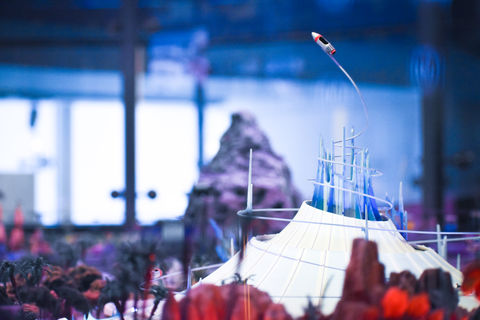
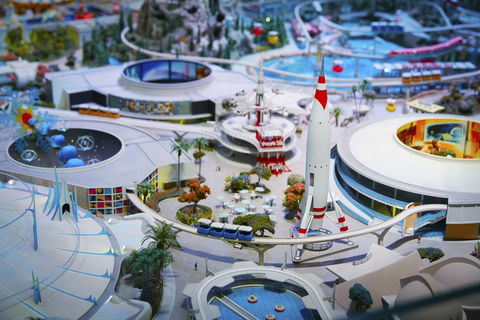
For more than 15 years, guests at The Walt Disney Family Museum have been mesmerized by the elaborate model of Disneyland situated near the end of the main galleries. Upon closer inspection, however, they are sometimes puzzled by its detailed appearance. Disneyland, in fact, never existed at any one point as it's represented in the model.
This “Disneyland of Walt’s Imagination” instead represents elements across the park that were envisioned by its creator at varying times. Some, like Pirates of the Caribbean and Haunted Mansion remain beloved favorites at Disneyland today. Others, like the Mine Train Thru Nature’s Wonderland and Adventure Thru Inner Space have long since disappeared from the Park, though they remain no less beloved to those who experienced them. One distinct piece of the model, however, never existed in its precise form outside of the imagination of Walt Disney and his Imagineers.
Tomorrowland’s “Space Port” complex is nestled in the park’s southeast corner and evokes a similar design to Space Mountain, the iconic thrill attraction which ultimately opened at Walt Disney World’s Magic Kingdom 50 years ago in 1975, and later at Disneyland in 1977. Walt had first envisioned his "Space Port" as something quite similar to what Space Mountain ultimately became, including an indoor roller coaster set within a dark space accented by projections of star fields, comets, nebulae, and asteroids. But it was never built in Walt’s lifetime, and spent a decade in various stages of development before evolving into the Space Mountain we know today.
We Begin in… Switzerland?
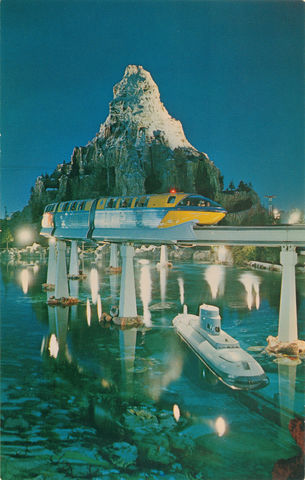
1959 had marked a sea change at Disneyland. Practically one quarter of the park had been transformed into half a dozen new attractions, most notably the Monorail (originally known as the Disneyland-Alweg Monorail System), the Submarine Voyage, and the Matterhorn Bobsleds. Each was an innovation in its own right, but as a roller coaster, the Matterhorn was also Disneyland’s first thrill attraction. Walt Disney was initially reluctant to embrace what he saw as amusement-park style rides. But the need to utilize a wooded hill in the park combined with a little inspiration from the production of The Walt Disney Studios’ live-action feature film, Third Man on the Mountain (1959), the WED Enterprises team and their collaborators at Arrow Development Company were able to devise a roller coaster that was innovative—the first of its kind to employ a tubular steel track—and conveyed appropriate theming that met the Disney standard.
“This immense structure met the Disney definition of a themed environment through an inspired combination of architecture, landscaping, and costuming,” wrote brothers Leon and Jack Janzen in The E-Ticket magazine. And as former Disney Imagineer Jason Surrell would note, the success of the Matterhorn Bobsleds “wore down Walt’s early resistance to the inclusion of traditional amusement park ‘scream machines’ at [Disneyland], opening his eyes to the almost limitless possibilities that new technologies presented as they began to play an ever-increasing role at WED.”
An Idea Ahead of its Time
At Disneyland’s Opening Day on July 17, 1955, Walt Disney dedicated Tomorrowland in a live television broadcast, proclaiming “tomorrow offers new frontiers in science, adventure, and ideals.” But for Walt, the land on Opening Day was not yet a fulfilment of that vision. The original Tomorrowland had little “adventure,” in particular. While the 1959 expansion was a constructive step forward, Walt remained committed to giving Tomorrowland a complete update.
As was the case with so many projects, however, Disney’s commitments to the 1964–1965 New York World’s Fair focused most of WED’s attention on developing attractions for the East Coast event. It was not until late in 1964, after the closure of the Fair’s initial season, that Walt approached the Imagineers with a new concept.
“Walt said, you know, it’d be great if we could take a ride like the Matterhorn [and] use a space theme,” remembered Imagineer John Hench. “[He] wanted to build a roller coaster-style ride, but in the dark, which no one had ever done before. He wanted to have precise control of the lighting and to be able to project moving images on the interior walls.”
By early 1965, both Hench and fellow Imagineer Herbert Ryman had created conceptual illustrations for the "Space Port" complex, as it was initially called. These drawings match the style of the attraction now represented in the museum’s model of Disneyland. “I think the original sketch was on an envelope, really, but it was drawn many times,” explained Hench. “I had an idea of a type of architecture which was kind of cartilaginous at the time, as [if] made out of lots of vertical parts that fit in certain ways.”
Following Walt’s lead, the Imagineers designed "Space Port" with a huge, swooping conical roof topped with space age elements which the team dubbed “satelloids.” Rocket ships flew both within and without the superstructure, a feature motivated in part by the Imagineers’ concerns that guests walking outside would not be able to grasp the concept of a fully-indoor roller coaster and risk passing the attraction by. PeopleMover vehicles, based on a ride system first employed at the New York World’s Fair, twisted their way through the bustling center—a feature that was ultimately included in both Disneyland and Walt Disney World.
In Walt Disney Productions’ 1965 Annual Report, the attraction concept was included amongst the company’s plans for an all-new Tomorrowland set to open in 1967. “In New Tomorrowland,” the booklet presented, “a towering structure will serve as spaceport and theme center. Inside, guests will board four-passenger ‘rocket ships’ to experience the sensation of racing through distant space. Spiraling upwards as high as an 18-story building, the ‘Tomorrowland Mountain’ will be the highest point in the Magic Kingdom [meaning Disneyland], a magnet visible for miles.” The report also included an aerial photograph of Disneyland with a superimposition of the new Tomorrowland plus an illustration of the original "Space Port" design.
By 1966, however, the attraction encountered technological limitations. As many as four individual tracks were envisioned for this innovative coaster, but the current-day ride systems didn’t provide necessary safety and dispatch controls that such a complex attraction would require. "Space Port" would have to be delayed. The 1966 Annual Report, published just days after Walt Disney’s death, stated that “a second phase of new Tomorrowland—featuring a ‘space mountain’ towering 20-stories high—will open in 1968.” This might have been the first public hint of the attraction’s ultimate name.
An East Coast Launch
The planned 1968 additional expansion at Disneyland’s Tomorrowland wouldn’t take place. In the aftermath of Walt Disney’s passing, WED Enterprises and much of the Disney company focused their efforts on opening what Walt had initially called “Disney World” in Florida. The Magic Kingdom finally opened in October 1971, and not unlike its California predecessor, the park’s Tomorrowland was left somewhat underdeveloped, ready for future expansions. In a twist of fate, the Space Mountain concept originally planned by Walt for Disneyland would instead open its first iteration at the park and vacation destination Roy O. Disney named “Walt Disney World” during its initial decade of operation.
“By the early 1970s… the world was well into the space age,” wrote Jason Surrell, “and if America could put a man on the moon, the Imagineers could manage to launch Walt Disney World guests into space.” NASA’s Project Gemini had been underway when Walt first envisioned a rocket ship-style roller coaster, and in the years since, the Apollo program had successfully landed astronauts on the surface of the moon.
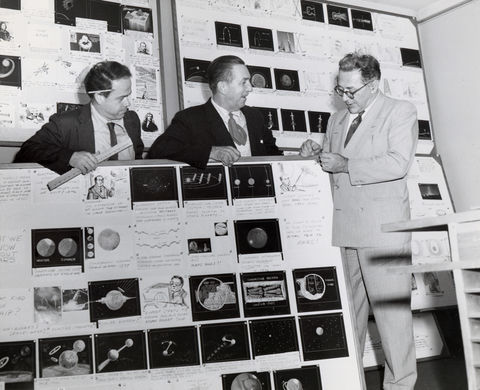
“In our modern world, everywhere we look, we see the influence science has upon our daily lives,” Walt himself explained in his “Man in Space” television episode from 1955. “Discoveries that were miracles a few short years ago are accepted as commonplace today. Many of the things that seem impossible now will become realities tomorrow.” In a befitting coincidence, the construction of Space Mountain at the Magic Kingdom began in December 1972, the same month that Apollo 17 astronauts Eugene Cernan and Harrison Schmitt walked on the moon, the last time that humans ever did so as of this writing. Their mission had launched on December 7 from Cape Kennedy—just more than 60 miles west of Walt Disney World.
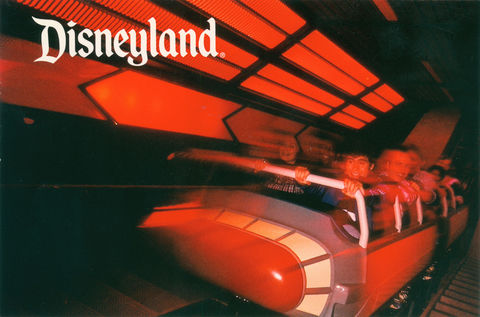
Standing 183 feet high and nearly two acres in size, Space Mountain opened at Magic Kingdom on January 15, 1975. American astronauts Scott Carpenter, Gordon Cooper, and Jim Irwin were in attendance. Sporting two individual tracks interweaving completely indoors, the ride benefited from a modern computer-based system that allowed for precise control. That same day, another Walt Disney attraction that debuted at the New York World’s Fair, the Carousel of Progress, opened as a transplant from California.
It had been just over ten years since Walt had first proposed the "Space Port" concept, and the press were keen to note that Space Mountain had been a Walt Disney idea, perhaps the last of its kind to finally be created at a Disney park. During the construction of its Disneyland counterpart, a voice recording by park announcer Jack Wagner explained to guests that “Space Mountain… will complete Walt Disney’s original dreams and visions for Tomorrowland.” Those dreams and visions may now be glimpsed in their original form at The Walt Disney Family Museum.

–Lucas Seastrom
Lucas O. Seastrom is a writer, filmmaker, and contracting historian for The Walt Disney Family Museum.
Image sources (listed in order of appearance):
- "Space Port" close-up on the Disneyland model; courtesy of The Walt Disney Family Museum
- Matterhorn Bobsleds, Monorail, and Submarine Voyage at Disneyland Park postcard; collection of the Walt Disney Family Foundation; © Disney
- Disneyland model Tomorrowland close-up; courtesy of The Walt Disney Family Museum
- Photograph – Ward Kimball, Walt Disney, and Willy Ley with storyboards for “Man in Space” program on Disneyland television show; May 1954; collections of the Walt Disney Archives and the Walt Disney Family Foundation, collection of Ward Kimball; © Disney
- Space Mountain at Disneyland Park postcard, June 5, 1998; collection of the Walt Disney Family Foundation; © Disney