
In 2001, the Walt Disney Family Foundation released Walt: The Man Behind the Myth, which aired on the Wonderful World of Disney in celebration of Walt’s 100th birthday. 25 years later, the still shows the many sides of the man, Walt Disney. Inspired by Walt’s daughter, Diane Disney Miller, and hosted by Disney Legend Dick Van Dyke, the film features clips from Disney family home movies along with interviews with friends, family, collaborators, and Disney historians. For this 25th anniversary, Executive Producer of the film and The Walt Disney Family Museum co-founder Walter E.D. Miller reflects on the film’s inception and impact in appreciation of Walt’s legacy.
How did the documentary project Walt: Man Behind the Myth first come about, and what sparked the decision to tell your grandfather's story through film?
The documentary project Walt: The Man Behind the Myth began with a conversation and suggestion from Richard and Katherine Greene and Pantheon Productions, [writer and director] Jean-Pierre Isbouts, and [producer] Cathie Labrador. They proposed the Walt Disney Family Foundation continue to collaborate with them in making a feature-length documentary about Walt Disney, in celebration of his approaching centennial anniversary.
We had worked with the Greenes and Pantheon Productions on a CD-ROM, Walt Disney: An Intimate History of the Man and His Magic. It was released in 1998—just as the interactive CD-ROM medium was being replaced by the internet; and, therefore, it did not sell well. Through Disney Online, we collaborated on a virtual museum—The Walt Disney Family Museum—which preceded the current brick-and-mortar museum at the Presidio in San Francisco.
It was only fitting to use the film medium to tell my mom’s father’s story, since he was one of the early pioneers in the film industry. We also felt that with domestic and international distribution, it would have the proper exposure to be seen and enjoyed in many households.
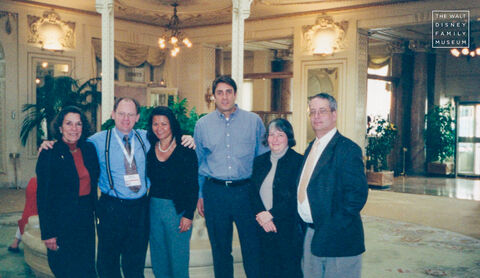
How did you and your mom first connect with Richard and Katherine Greene, and what role did they play in bringing the documentary to life?
My mom first connected with Richard and Katherine Greene in what must have been the ’80s. They wrote a book in 1991, Walt Disney: The Man Behind the Magic, for both children and adults to enjoy. I believe they reached out to my mom when they were researching the book. It was the beginning of a long friendship. My mom would often call the Greenes to discuss her father, or some of the projects we were working on. The Greenes’ day job was as busy journalists with deadlines to meet, but they were always eager and willing to spend hours on the phone with her. She was quite fond of them, as am I. My mom had a habit of calling and getting right into the subject at hand with little else, so I’m sure even if they were swamped with approaching deadlines, they wouldn’t have had the opportunity to stop my mom’s train of thought.
The Greenes not only had a role with many of our Walt Disney legacy projects… They had developed a great working relationship with Jean-Pierre Isbouts and his wife Cathie Labrador of Pantheon Productions, so it was a very collaborative process between the four of them, my mom, myself, and the Walt Disney Family Foundation. They wrote the screenplay and co-produced the film.
Before the documentary, several books had been published that your family felt were inaccurate representations of your grandfather. What did your family hope this film would accomplish, and what did you most want audiences to take away about him?
As I recall, there was one book in particular that really bothered my mom. It was full of inaccuracies and lies. Before the film production began, and before we commenced the CD-ROM project, I remember my mom put together an advisory committee of sorts, even though it wasn’t that formal. We had a dinner in Santa Monica, probably in the mid-’90s, for which Richard and Katherine Greene flew in from New York; [animation critic and historian] Charles Solomon and [animator] Scott Johnston were in attendance; and Howard Green from The Walt Disney Studios was also there. Historian Paul Anderson might have been there as well. It was a long time ago.
It wasn’t just a conversation about how to counter the mistruths that were being spread about her dad, it was also about how, as a family, we can promote the man. Because there was so much interest in him, in a positive way, he was becoming a brand, and she wanted to tell the real story of her father, whom she knew better than anyone. The man she knew was a very decent man. That’s what she always wanted to portray… that he was a very decent man who happened to be a visionary—but at the same time was a very approachable and down-to-earth person who treated everyone as an equal.
When my mom would be asked questions about what a genius her father was, she would sometimes become annoyed and reply, “God, it’s not like he invented the cure for cancer or anything.”
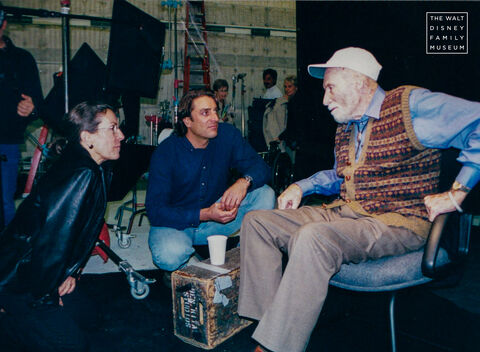
Looking back on the interviews and research that went into the documentary, was there anything you learned about your grandfather, or about how his story had been told, that changed your own perspective on him?
The entire process of pre-production of making the documentary was an eye-opening, learning experience. To hear firsthand from all the different people we interviewed, from the men and women who worked directly with him, or the historians who researched him for decades, to union members who picketed the studio and were not fans of our grampa, was all an in-depth learning experience.
To hear from Art Linkletter talk about the first time he met Walt at some speaking engagement: he’d walked into the venue early, and there was a man rearranging the chairs. And he walked up to him and said, “I hear Walt Disney is going to be here today.” To which my grampa replied, “I’m Walt Disney.” It says so much about the man: he was immersed in everything. He was always plussing—improving upon—[with] his incredible work ethic, to make [things] better, but was just a down-to-earth guy.
Ray Bradbury talked about recognizing Walt at a department store where he had his arms full of Christmas presents, and before [he could say] “It was nice to have met you, Mr. Disney,” Walt was inviting him to visit the studio within the next week. As busy as he was, he was always approachable and eager to collaborate on the creative process.
Charles Solomon said that watching the remaining Nine Old Men being interviewed—Marc Davis, Ollie Johnston, Frank Thomas, Ward Kimball—and others that worked with him, such as John Hench—all of them spoke about working with Walt as if it were yesterday, and became emotional with grieving his loss some 40 years later, but also seemed to be competitive about whom Walt liked best amongst themselves.
As some we interviewed described, as intimidating a presence he could be—especially in the sweatbox sessions—he was aware of what every animator, artist, individual working at the studio was doing. And some of those assuming that they were invisible to their boss, Walt Disney, would be acknowledged by their first name in passing [him] on the studio lot.
He was fully immersed in it all. And as John Hench said, “He just wanted to get on with it, always.”
How did the process of making the documentary influence the way you and your mom approached the development of The Walt Disney Family Museum?
I think the way the documentary most influenced the way my mom and I shaped the development of The Walt Disney Family Museum was the frustration of just how limited a two-hour documentary was to tell the story of my mom’s dad. During the making of the film, I envisioned it being more like a Ken Burns [style] multi-episode documentary series. There were just too many stories about the man, Walt Disney, but also all the side stories—the B-roll, so to speak—of all that occurred during the short life of this visionary man who burned so bright.
The bricks-and-mortar museum concept goes way back, and far preceded the documentary film. There were two things that planted the museum seed. One was my sister Joanna urging my mom to have all the awards that were in Retlaw storage —collecting dust—put on display in the old Retlaw office building. [Retlaw, which is “Walter” spelled backward, was the family’s personal company.] We built display cases for them, and once they were all on display, we all said it was like a museum. I don’t think my mom had any idea of just how many awards and award certificates her father had received over the years.
The other event that influenced the idea of the museum and the documentary film was when my mom decided it was time to see what was in all the old cans of family films that came from her dad’s home. She kept them in a dark closet in our family home in Encino for decades. With the help of Jeff Kaye from Retlaw, we found a post-production facility and the editor, Scott Zone, who over many weeks delicately restored and corrected the old films. My mom would fly down to Burbank every Friday for weeks, and she and I would go sit in the edit bay with Scott and watch the treasure trove of that week’s worth of family film he’d restored. My mom had not seen most of the films. She was mesmerized by what this discovery unearthed, as was I.
In the mid-90s, shortly after these events, my mom and I met with Los Angeles Mayor Richard Riordan at his office to see if the city would be interested in helping establish a Walt Disney Museum. For a short while, they were interested, suggesting it be located in Griffith Park, but ultimately it didn’t work out. That’s when Richard and Katherine Greene suggested the idea of a virtual museum, and along with Pantheon Productions, we launched The Walt Disney Family Museum online.
Ultimately, with the building of The Walt Disney Family Museum in Presidio of San Francisco, we had the space to tell the whole story of Walt Disney . But even with the square footage and within the walls of the space, and all of the text panels, monitors, etc., we still could not fit this man’s incredibly full life’s content entirely; but with the museum’s special exhibitions and theater programming, our dedicated museum staff fills in the holes.
Were there particular stories, interviews, or discoveries from the documentary that helped shape the museum's approach to telling your grandfather's story and preserving his legacy?
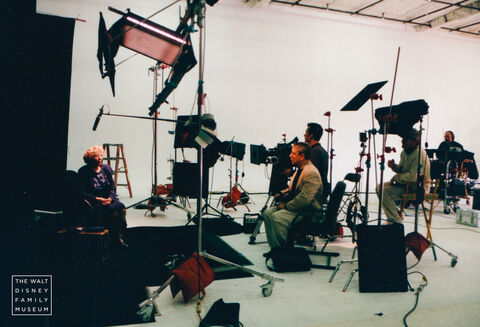
From the documentary, what was probably a key contribution to the idea of us pursuing the museum today were the reels and reels of on-camera interviews we did during the production of the film.
When we closed down Retlaw Enterprises and the Retlaw building in North Hollywood, we relocated the entire collection—now part of the Walt Disney Family Foundation—to the Presidio, in a small warehouse building on Gorgas Avenue. We built it out to display the awards in the same cases, [along with] the Carolwood Pacific Railroad train, the two little Autopia cars that Walt gifted to his grandchildren Chris and Joanna, and the Ub Iwerks Optical Printer #2 artifact that Don Iwerks donated to the Foundation. We installed a monitor to showcase all the on-camera interviews we shot, all accessible from a main menu kiosk.
We had a little museum on our hands—located in a national recreation area—which my mom wanted to open to the public on a very limited basis. We brought in a museum consultant, Marci Goodwin, and upon seeing the limitations of warehouse space and location and total lack of any feasible parking, she said, “It’s not a matter of getting the visitors here, it’s a matter of keeping them out!”
And that’s when we started looking at expanding to the barracks building up the road.
Do you have any standout memories of a particular interview that was given or moment during the development of the film?
There are too many standout memories to count. Visiting Marceline and Kansas City, Missouri locations were highlights. Visiting the old farm location where Elias had so much hope for his family’s success living and working on a farm, which only lasted a short four years, but four years that had such a strong impact on Walt’s life. The interviews for the film... we never knew what to expect. Richard and Katherine Greene did a great job interviewing everyone, as did Cathie Labrador in scheduling it all, and Jean-Pierre, setting up the shoot that was all on film rather than video. We had to stop and reload the camera sometimes just as those being interviewed were getting comfortable and candid.
Do you have favorite stories?
- Hearing Bob Gurr talk about working with Walt in the creation of Disneyland, and then years later, piloting the Monorail with Vice President Nixon on board—but closing the doors before the Secret Service boarded,
- Don Iwerks and Michael Broggie, talking about their dads working together with Walt to create so many cutting-edge technical achievements—out of that little machine shop on the studio lot,
- And hearing Richard Fleischer, the son of Betty Boop animator Max Fleischer, who Walt hired to direct 20,000 Leagues Under the Sea (1954), talk about going to his father Max to tell him he was going to work for Walt, knowing how much animosity he’d had against Walt, an animation rival from many decades earlier,
- Or John Hench discussing how while in Disneyland he would sometimes be mistaken for Walt Disney, and in one particular humorous situation, Walt and Hench standing together on the deck of the Mark Twain Riverboat with visitors pointing toward Walt saying, “There is Walt Disney!” …and my grampa shaking his head as ‘no, you got the wrong guy’ and then [...] redirecting everyone’s attention to Hench,
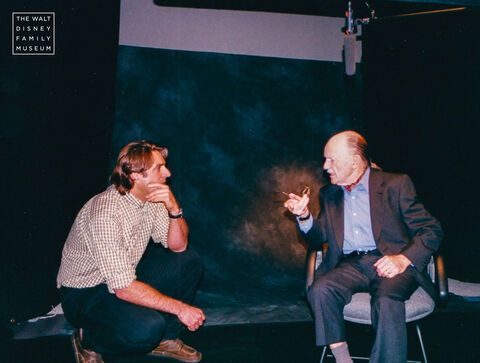
- Or Peter Ellenshaw talking about working with Walt on Darby O’Gill and the Little People [1959] and many other films, and ultimately on Mary Poppins [1964].
I could go on and on.
When you think about the documentary today, what do you feel it accomplished that you couldn't have accomplished through a book or another type of storytelling?
I think that 25 years later the documentary holds up incredibly well. At the time of its release, there really was nothing else like it available. We conducted more on-camera interviews—with those who worked with Walt, or studied his life and career, or those who were close to him—than ever before. I wanted to keep those interviews going, and years later, Jeff Kurtti, Bruce Gordon, and I had planned on it, but in the end, for whatever reason, it didn’t happen. Most everyone is gone now. Don Peri did continue to do audio interviews for the Walt Disney Family Foundation, with many people who knew and worked with Walt, but there is something so special about on-camera first-person interviews that are so personal. Through these interviews, their legacies will all live on.
My mom was as accessible and approachable as her father was, and many people would seek my mom out to learn more about her father. She would willingly and eagerly meet them at the museum, give them a hard-hat tour of the building under construction—or, upon its completion, walk them through the galleries. And she was just as eager to learn more about her father—his career, and the men and women who worked alongside him—as were those she was greeting. She [regularly] made the trip back and forth between my dad’s and her home in Napa Valley. Many of those she met would come with a manuscript they’d written, hoping that my mom would read it and possibly publish it through the Walt Disney Family Foundation Press.
My mom loved reading. She devoured books in a single sitting. I think she preferred written books about her father to a biographical documentary film.
Towards the end of my mom’s life, someone asked her when she was going to write her memoirs, to which she replied that she didn’t think she had to, because The Walt Disney Family Museum was her memoir.
—Walter Miller, grandson of Walt Disney and co-founder of The Walt Disney Family Museum,
in conversation with Bri Bertolaccini, Content and Research Manager
Image sources (listed in order of appearance):
- Walter Miller and Peter Ellenshaw during filming of interviews for Walt: The Man Behind the Myth (2001), c. 2000; courtesy of Walter E.D. Miller
- Diane Disney Miller, Jean-Pierre Isbouts, Catherine Labrador, Walter Miller, Katherine and Richard Greene, at Walt: The Man Behind the Myth screening, 2001; courtesy of Walter E.D. Miller
- Diane and Walter Miller with Bill Evans during filming of interviews for Walt: The Man Behind the Myth (2001), 2000; courtesy of Walter E.D. Miller
- Virginia Davis being interviewed for Walt: The Man Behind the Myth (2001), c. 2000; courtesy of Walter E.D. Miller