
“I was born in 1955, which is appropriate, because that’s when Disneyland was born,” says Don Hahn, a Disney Legend and Academy Award® winning producer of beloved classics like Beauty and the Beast (1991) and The Lion King (1994), and most recently, curator of The Walt Disney Family Museum’s special exhibition, Happiest Place on Earth: The Disneyland Story.
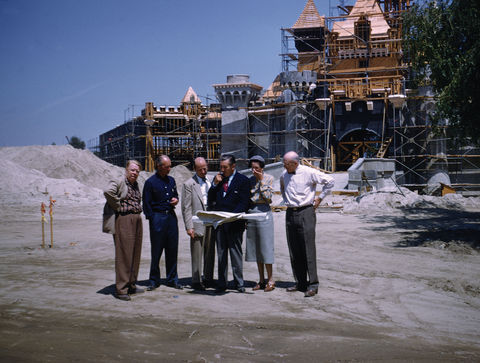
Growing up in Southern California, Hahn recalls Disneyland as “an otherworldly place,” as he puts it. “As with any good movie or good story, it’s that willful suspension of disbelief where you get transported out of your everyday life and suddenly you’re within the berm of Disneyland. You could do anything. At certain times, my parents would drop me off with a friend and it was just the two of us running around. There was no other place like that.”
Of equal importance to Hahn during childhood was the Disneyland television program, later renamed Walt Disney’s Wonderful World of Color, and hosted, of course, by Walt Disney himself.
“My family was the classic audience for Disney,” Hahn recalls. “It was the post-war 1950s with a black-and-white TV with three channels. You had Jack Benny, Ed Sullivan, a little bit of news, and it went off the air at 11 o’clock at night. The Disneyland show and the Mickey Mouse Club became iconic. You had to watch those every week. The show really familiarized all of us with this ‘Uncle Walt’ guy. He was as important as any character when you were a kid because he would take you by the hand to places where you couldn’t normally go in your everyday life.”
With Walt himself as a guide, the television program often took viewers behind the scenes of the Sudios’ latest projects, and, in particular, those at Disneyland. “You could watch Imagineers rip cannonball holes in sails on a pirate ship,” says Hahn. “That stuff was really impressive to me because, suddenly, I was aware that there were people who did that for a living. You could see the magicians working.”
Becoming a Historian
As he grew up, Hahn “just loved the idea of working at Disney.” In 1976, he took a job at the Disney Studios as what he calls “a delivery guy, taking scenes around, and working in the ‘morgue’ where the old artwork was stored. I could take scenes up to [iconic animators and Disney Legends] Frank Thomas and Ollie Johnston.”
After many decades at the Studios working across both animated and live-action film productions, Hahn became a Disney historian in his own right, making documentaries like Waking Sleeping Beauty (2009) and Howard (2018), writing books like Yesterday’s Tomorrow: Disney’s Magical Mid-Century (2017), and curating special exhibitions at The Walt Disney Family Museum like Walt Disney’s Nine Old Men: Masters of Animation (2018–19). The current Disneyland special exhibition at the museum was inspired by Hahn’s latest book, The Happiest Place on Earth: The Incredible Story of Walt Disney’s Disneyland, co-authored with historian and former Walt Disney Imagineer Christopher Merritt.
“There is no one on the planet, with the exception of Tom Morris [another former Imagineer], who is more deeply invested in the mythology and people of Disneyland,” says Hahn about his co-author. “Over the years, Chris talked with me about this book idea, and we eventually took the concept to [Disney Editions editorial director] Wendy Lefkon and asked if there was something we could do with it. This was way before the 70th anniversary. As time went on, the project grew and people at Walt Disney Imagineering kept showing us more things. It was this snowball of events that turned into the ultimate book. Chris was the driver early on. My strengths are writing and storytelling. I wanted to put a human face on the Park’s history and give credit to the people that made it.”
Going Deep into the Disneyland Story
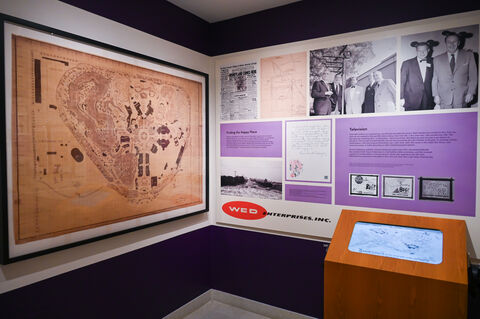
That same vision influenced the museum’s special exhibition, which, like the book, focuses on Disneyland’s history during Walt’s lifetime, from 1955–1966. “To show the genesis, the origin story of Disneyland, is always what we wanted to do,” notes Hahn. This includes charting many of the disparate influences that eventually coalesced into Walt’s vision for the Park, in addition to the practical means he developed to fund and construct it.
“What was the deal with ABC and how did that happen?” says Hahn. “What was the Chicago Railroad Fair, and what was Walt’s trip there like? It was all really fascinating to me because that’s where Disneyland came from. Yes, there is the story of the [Griffith Park] carousel and Walt’s daughters and something to do on a weekend, but the real grit of creating the Park had so much more to it.”
Even for passionate fans of Walt Disney and the artists who collaborated with him, there is much, much more to learn. Take an example like Disney Legend Herb Ryman’s iconic, illustrated map of Disneyland from 1953, which Roy O. Disney used to help pitch the concept for the Park to financial investors. As the research by Merritt, Hahn, Tom Morris, and others has helped uncover, there is more to the story.
“[Studio designer and Disney Legend] Marvin Davis actually drew many different maps before we ever got to Herb Ryman’s famous map,” says Hahn. “One of Marvin Davis’ maps even appears on Herb Ryman’s drawing, so we wanted to dig into all of that. Davis went through many phases for years to get to the stage where Ryman could do his map.”
Such early maps imply that Walt and team “were designing a Park for a large piece of land before they had any money or any land to speak of,” Hahn adds. “Eventually they had multiple properties they were considering and they whittled it down, which is not exactly the story that we’d understood for years. We didn’t know about how [early Imagineer] Nat Winecoff went to the Anaheim Halloween Parade and kind of bartered with the city representatives in a parking lot for all of this land, which was about 17 parcels, and involved closing down a street. It’s all so fascinating because it shows how things really happened and how chaotic it was.”
From a Book to an Exhibition
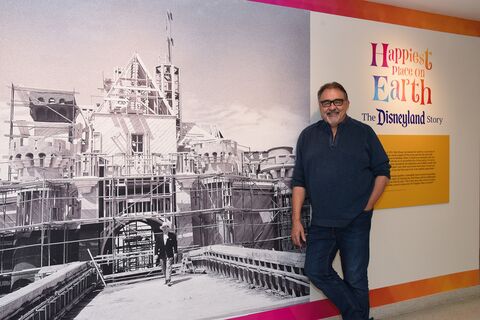
To adapt the book’s many themes and subject matter into the museum exhibition, Hahn partnered with The Walt Disney Family Museum’s Director of Exhibitions & Collections Marina Villar Delgado and her team. Winnie Ho, the book’s original designer, also consulted, helping to determine colors and other aspects of the special exhibition’s design. The overall challenge was to translate years of research into something different from what a book can do, creating a physical, emotional experience with tangible artifacts and a companion film.
“Not only did we put the book on the walls, in a way, but we put much, much more of things you’ve never seen before,” says Hahn. “And we incorporated film elements. The whole Golden Horseshoe Revue with [Disney Legend] Wally Boag is on a monitor, and right beneath it are his bag and his props, including his ‘teeth’ that he used to spit out. We also did a film that covers some of the business backstory about the Park.”
Items from the museum archive that appear in the special exhibition include original illustrations, such as early costume designs for the Park’s cast members by Hollywood costume designer Renié Conley and drawings by studio artist Bruce Bushman of the unbuilt pirate wax museum walkthrough attraction that later evolved into Pirates of the Caribbean. Each artifact emphasizes the specific contribution of an individual to the Disneyland story. That includes Walt himself. Among the treasures displayed in the Adventureland section are two mechanized, autonomous birds in a gold cage reminiscent of a similar one owned by Walt that helped inspire the development of Audio-Animatronics® technology and, eventually, Walt Disney’s Enchanted Tiki Room.
Learning from Walt
In studying the origins of Disneyland—and as a student of Disney history in general—Hahn has picked up a few insights about the man who made it all possible. One of the key attributes he identifies for Walt is persistence.
“I didn’t know Walt, and I can only guess, but there are things in his life that I think had more of an influence on him than we realize. I think spending a year in France when you’re 17 years old is huge. It’s one thing that we might discount. Then [after] he got back, the abandonment he went through when he was 20 years old… his brothers had all gone away, and his parents moved to Oregon. Everybody was gone. He was alone, taking a shower once a week at the Kansas City railroad station. That’s trauma.”
“You realize how important his friends were,” Hahn continues, “How Ub Iwerks saved his neck, pretty much. How Virginia Davis’ mom was willing to move their family out to California. How his distributor was willing to take a risk on him. Walt said he could do it, and he goes and springs Roy out of the hospital. It shows this fearlessness and persistence along with some really wonderful, childlike imagination and curiosity. ‘No’ was not in the vocabulary. All of those things kind of add up to who Walt was.”
Hahn thinks of Walt as “a capitalist with a small ‘c,’” in the sense that he was remarkably adept at capitalizing on the moment in time, whether it’s his arrival in Hollywood in 1923 when the city’s motion picture industry was on the cusp of a new renaissance, or after World War II, when Americans were seeking forms of entertainment for their growing families.
“You have all these soldiers and sailors coming to settle down in Southern California, the home of show business,” Hahn says. “Everyone’s having families, building houses, and buying television sets. Urban sprawl is taking place. Walt sees that they can take advantage of this. He’s the ultimate opportunist. There was a population boom, a technology boom, and readily accessible land away from the smog of Los Angeles, and he had all these artists working for him. Let’s go do this. He could put the puzzle pieces together in a way that very few people could.”
The Park that resulted was, in a manner of speaking, a movie in itself, as Hahn sees it. “One of the first places Walt visited when he came to Los Angeles in 1923 is Universal City, which is where he was able to roam through the studio,” he explains. “Back then, it was silent movies, so they had bleachers where you could sit and watch them film, because they weren’t recording sound. You can imagine this young Walt sitting there at Universal City, the home of backlot tours, and do you think that made an impression?”
“Disneyland is a movie. It is storytelling,” Hahn continues. “You walk in and cross-dissolve from the parking lot into Town Square. You can leave your world behind and experience it, from the hub, in a series of cross-dissolves to wherever you want to go and have those kinds of movie-like experiences. It was made by moviemakers, people who did set design and visual effects.”
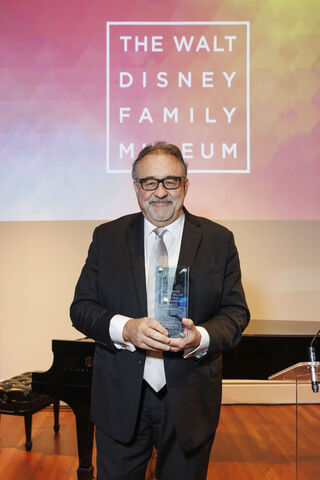
The Diane Disney Miller Lifetime Achievement Award
At the special exhibition’s opening, the museum recognized Hahn with the Diane Disney Miller Lifetime Achievement Award. “It was a surprise and an honor, absolutely, to be mentioned in that context,” he says. Hahn got to know the award’s namesake when he was among those invited to join an advisory group that consulted in the development of The Walt Disney Family Museum ahead of its 2009 opening.
“We’d walk around the construction site and Diane was there with a hard hat on,” Hahn recalls. “I always admired her tenacity and ability to get it done, and also her willingness to be honest about the story. It was not going to be a puff piece. It was going to include the challenges of Walt’s life, which I think is important because we can relate to it as humans, and it makes it much more heroic on Walt’s part.”
Reflecting on the combined legacy of Miller and her father, Hahn sees the museum today as a dedicated place where a like-minded community can gather together to celebrate the power of storytelling. What he describes as “shared sensibilities,” like friendship, making art, and the love and passion for Walt Disney’s creations, are fostered at the museum.
“Whether you’re a kid taking art lessons or an adult feeling the nostalgia of Walt Disney’s era, it’s a place where you can look back and say, ‘How lucky were we to hear these stories and be in the world at the time that we were?’ And it’s preserved here at the museum. You can look around the room and see like-minded people who are as moved by these stories as I am. It’s that place of communal gathering, experiences that go way back in our DNA as storytellers, and that’s so important.”
—Lucas O. Seastrom
Lucas O. Seastrom is a writer, filmmaker, and contracting historian for The Walt Disney Family Museum.
Image sources (listed in order of appearance):
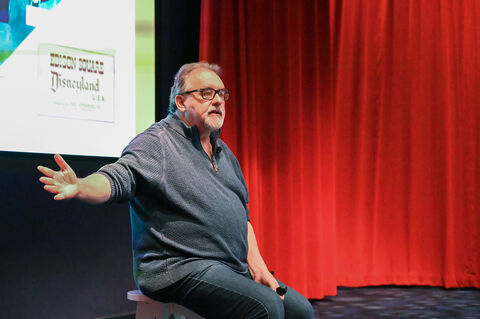
- Photograph – Disney Legend Don Hahn at the Happiest Place on Earth: The Disneyland Story curator talk; courtesy of The Walt Disney Family Museum; Disneyland logo © Disney; © The Walt Disney Family Museum
- Photograph - Harper Goff, Bill Evans, Dick Irvine, Walt Disney, Ruth Shellhorn, and Joe Fowler examine working drawings, April 1955; Courtesy of Ruth Patricia Shellhorn Papers, UCLA Library Special Collections, © Disney
- Photograph – Happiest Place on Earth: The Disneyland Story; courtesy of The Walt Disney Family Museum; artwork and Disney images © Disney; © The Walt Disney Family Museum
- Photograph – Disney Legend Don Hahn at Happiest Place on Earth: The Disneyland Story, 2025.11.13; © The Walt Disney Family Museum
- Photograph - Don Hahn receiving the Diane Disney Miller Lifetime Achievement Award, 2025.11.11; © The Walt Disney Family Museum