
Author Michael Campbell’s earliest childhood memory is of a Disney train. Visiting Disneyland® Park at the age of six, young Campbell was already a budding railroad enthusiast and had convinced his parents to let him dress up as an engineer for this fateful first visit to the Park. “I have a special gene, that’s actually fairly common,” he quips, “that creates an irrational love of trains.”
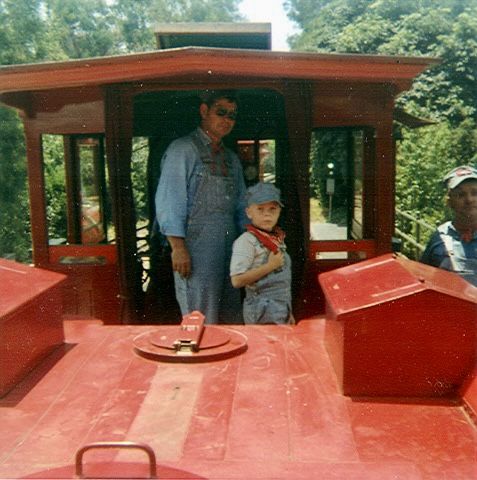
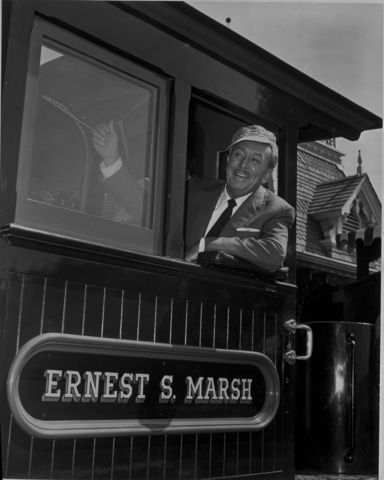
There was only one first attraction to choose, of course, and Campbell made the short climb from Town Square up to Main Street Station for the Disneyland Railroad. “The Ernest S. Marsh came rolling in,” he recalls, “and I went to get on the first passenger car behind the tender, so I could have a great view of everything. I guess the conductor noticed this excited little kid dressed up as an engineer.” The Cast Member soon escorted the small boy up to the locomotive itself and introduced him to the crew. As it was time to go, the engineer brought Campbell up to his lap.
“He told me to grab the whistle-pull and sound it twice. I knew that meant we were leaving. So, I got a grand circle tour from the best possible seat in the Park. It’s been more than 50 years, but I can tell you what it smelled like and what the heat felt like from the back of the boiler. It was thrilling, a little scary, exhilarating, and it seared into my mind my love of trains. You could never get a similar ride today, by the way. It was a different world back then.”
This proved the first of many continuing adventures that Michael Campbell has had in the world of Disney steam trains, not least of which includes serving as curator of The Walt Disney Family Museum’s 2014 special exhibition, All Aboard: A Celebration of Walt’s Trains. Its companion book, Walt Disney’s Trains: A Grand Circle Tour Through his Life and Legacy—also written by Campbell—is newly available for purchase.
A Constant in Walt Disney’s Life
“Trains play both a physical and symbolic role in Walt’s life,” says Campbell, who stresses the importance of understanding the practical context that railroads played in the lives of Americans for close to a century. Walt Disney grew up in a world where railroads were not only the most efficient form of cross-country travel in most cases, but also among the largest corporations and employers. “A lot of families grew up with personal connections to railroading,” notes Campbell, “and that included Walt, whose ‘uncle,’ Mike Martin, worked on the Santa Fe [Railroad].”
Famously, one of Walt’s first jobs was as a news butch on regional lines in Missouri, selling newspapers, candy, and other items to passengers. On breaks, he would climb up and over the coal-laden tender to the locomotive where he would interact with the engineers. The experience helped instill within Walt a fascination with the mechanical power of trains and the romance of where they can take you. More than once in Walt’s lifetime, train travel was involved in pivotal moments, including his first departure for Hollywood in 1923 and his return from New York later in the decade when, as Walt would later recount, Mickey Mouse was named by his wife Lillian Disney.
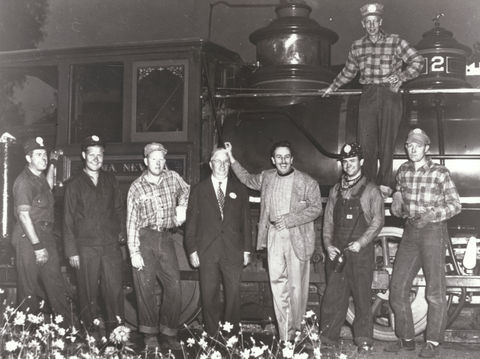
By the mid-1940s, the railroad took on increased significance for Walt on a personal level. “Walt was really stressed out in those years,” Campbell explains. “World War II had essentially shut down The [Walt Disney] Studios’ regular operations.. The Walt Disney Studios contributed to the Allies' war effort by devoting over 90% of its output to producing original artwork, as well as training and public-service films. Before the war, there was the strike and the financial difficulties with films like Pinocchio [1940].” In the midst of trial and uncertainty, one of Walt’s employees, animator and Disney Legend Ward Kimball—whom Campbell describes as “like a cross between Leonardo DaVinci and Harpo Marx”—invited Walt to come visit his full-size backyard railroad.
“That helped Walt reconnect with the experience of being a news butch,” Campbell says. “When you climb up into the cab of an engine as large as Kimball’s Emma Nevada, the thing feels alive. It’s warm, it makes breathing noises, and it responds to your touch. It’s a machine, but it’s not like turning on a blender. The sense of freedom and power you get when you blow the whistle and open up the throttle is almost indescribable. I can imagine that Walt had some kind of epiphany at that moment.”
“But of course, there were still difficulties at the Studios, and he was looking for ways to relax,” Campbell adds. “So he gets a Lionel model train set in his office, which is how he connects with animator [and Disney Legend] Ollie Johnston about his train passion as well. Then, eventually, Walt has the idea to go to the Chicago Railroad Fair with Kimball. That experience leads to Walt wanting to have his own train. He loved miniatures and that’s how the Lilly Belle story came about.”
“My Train Guy”
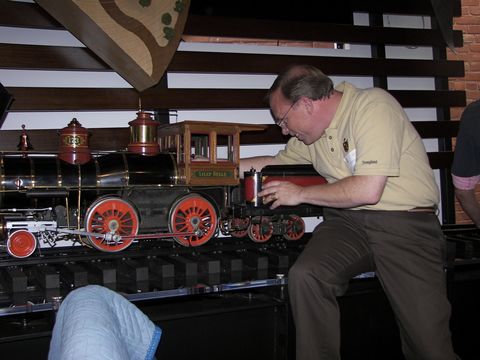
Over the years, Campbell has learned a thing or two about Walt’s 1/8th-scale live-steam locomotive, the Lilly Belle, named for Lillian Disney, which looped the Disney family’s backyard railroad, the Carolwood Pacific. Beginning in the late 1990s, Campbell had the opportunity to view it up close. As a Silicon Valley-based executive, he had not strayed from his railroad passion outside of work and aspired to create licensed model replicas of the Lilly Belle.
Through mutual acquaintances, Campbell was introduced to Diane Disney Miller. Pitching his concept for the collectible product line, Campbell recalls that Diane actually disliked the idea at first. “‘There’s no way anybody is going to commercialize my dad’s personal life,’” Campbell remembers her saying. “I was surprised but I understood. I stayed in touch with Diane, and I believe that she was ultimately persuaded to allow the model to be made because it was a way that she could help control the message of her dad’s personal hobby, and to make sure that it connects with kids. People will buy this because it looks great and then they’ll learn about Walt as a human being.
“This was very important to Diane around this time,” Campbell continues. “Walt was becoming more of a corporate symbol. A survey had been made of college students and most identified Walt Disney as a fictional character, someone who never existed, like Betty Crocker. That bugged Diane. There was inspiration to take from Walt’s real life.”
Miller began referring to Campbell as “my train guy,” and with the Lilly Belle as a focal point, they curated a special exhibition on Walt’s love of trains at the California State Railroad Museum between 2002–03. “The Museum attributed an increase of visitors during that period of 400,000 people,” Campbell notes. “Between that and the earlier success of a Walt exhibit at the Ronald Reagan Presidential Library, it really sealed the idea that this stuff needed to be out there.”
What eventually would open in 2009 as The Walt Disney Family Museum soon went into active development, and Campbell was there to advise on all its many railroading aspects. “Diane’s ideas were growing,” Campbell notes. “She wanted to bring school groups through. She wanted to set up a research library. It wasn’t going to fit in the warehouse she had. So Bruce Gordon, the former Imagineer, said, ‘You know, your dad had one of the biggest lives ever, and there should be a big museum to tell that story.’”
Crafting an Exhibition
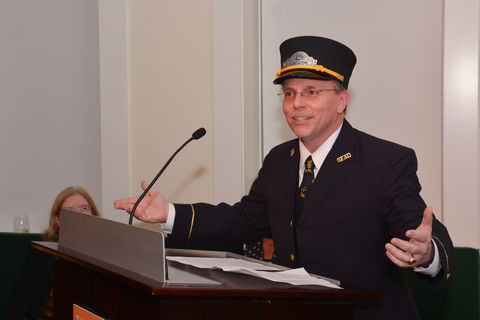
With The Walt Disney Family Museum’s debut, Campbell soon proposed a special exhibition about Walt’s railroad passions. After Diane Disney Miller passed away in late 2013, her husband Ron Miller gave the concept the final green light. All Aboard was not only one of the first special exhibitions to open after Diane’s passing, but also the first about Walt himself.
“Up to this point, everything was about the product that Walt and his company had created,” says Campbell. “This exhibition was about him as a person and that tied right back to Diane’s purpose for building the museum.” To craft the special exhibition’s story, Campbell followed Walt’s own lead, referencing his 1965 article from Railroad magazine, “I Have Always Loved Trains.” “There was no way I could top one of the greatest storytellers in history,” Campbell reflects, “so I let him tell his own story.”
For Campbell, the special exhibition’s central theme was encapsulated by Walt’s quote, “You may not realize it when it happens, but a kick in the teeth may be the best thing in the world for you.” This characteristic wisdom is found in a story like the creation of Mickey Mouse.
“If Oswald the Lucky Rabbit hadn’t been taken away from Walt, would we have Mickey Mouse?” Campbell speculates. “Would something more important have been taken from him later? We don’t know. The message there is that you cannot control what happens to you, but you can control how you react to it. When people are faced with similar situations, when someone takes advantage of them, what would they do? They might get mad, feel despondent, decide to give up. We don’t know for certain, but I suspect some of those things ran through Walt’s mind.
“Walt made a comment to Lilly,” Campbell continues, “where he said, ‘I’m done with Oswald. We’re going to have our own character.’ And he made sure he had the exclusive rights, and the world changed because of it all. Mickey Mouse is one of the things that you can truly say is world famous. When terrible things happen to you, recognize that it might be one of the best things happening to you, but in disguise. If guests remember anything from that exhibition, I hope it is that message because that is one thing that every single person can use.”
A Small-Scale Hobby with an Outsized Legacy
These stories and many others are also present in Campbell’s new book, Walt Disney’s Trains: A Grand Circle Tour Through his Life and Legacy. His writing goes to the heart of Walt’s most beloved hobby, which bore a far-reaching legacy. “Sometimes people look at this aspect of Walt’s life through the lens of ‘a poor guy gets rich and makes a big expensive toy,’” Campbell notes. “I guess that’s not exactly wrong, but it misses the point.”
“Up to that time,” Campbell explains. “Walt had a horse or two, and he liked miniatures, but he didn’t spend a lot of money on extravagances. Most of the money he made went back into the studio. After he and Lilly—one of his employees—got married on a Friday in 1925, they were back at work on Monday. Lilly later remarked that the only thing that changed was that her salary stopped! Roy O. Disney described the railroad hobby as the first real extravagance that Walt ever had. And, of course, it wasn’t an isolated thing. It led him down the path towards building a new form of entertainment with Disneyland.”
That tale—now told in The Walt Disney Family Museum’s current special exhibition, Happiest Place on Earth: The Disneyland Story—helps us to understand how the vision for Disneyland began with Walt looking outward for pleasure, enjoyment, and fulfillment outside of his work. His insatiable curiosity and openness to new ideas—as Campbell elucidates—were essential qualities in Walt’s life and something we can all take inspiration from.
“There’s one of the Sherlock Holmes stories that kind of sums up the difference between the Walt mentality and a lot of other folks,” Campbell explains. “Holmes asks Watson how many times he’s walked up the stairs to Holmes’ room, and Watson replies that he must’ve done so hundreds of times. Then he asks for the number of steps along the staircase, and Watson doesn’t know. Holmes tells his friend that ‘you see but you do not observe.’ He then explains that it has 17 steps, which he knows because has done both.
“That’s the difference,” Campbell says. “Walt observed. He wanted to learn from things and find out how to make use of them. A lot of people want to try to predict what Walt would have thought, but Diane was not one of them. She explained that nobody knew how he thought. He continually surprised people who’d been working with him for 30 years. But a theme that you can observe is that when he experienced something, it wasn’t just a fleeting moment in time. Walt filed it away to possibly be used later.”
“You Would’ve Gotten Along with Dad”
As Campbell looks back on his years collaborating with Diane Disney Miller in support of The Walt Disney Family Museum, he recalls one early memory when, during a pitch session for an exhibition, he began to describe elements of the Lilly Belle train to Miller with giddy excitement.
“Diane was listening,” Campbell explains, “and there was a pause. She stared at me for a moment, and said, ‘You would’ve gotten along with Dad.’ And the thing is, I don’t think she meant it as a compliment [laughs]! It was that so-called special gene of rail fans!” Her own bemusement aside, that railroad passion was something that Miller made great efforts to explain to the world.
“When Walt was in his backyard on the Carolwood Pacific, he was not a big shot Hollywood studio executive, he was just a guy working on trains,” Campbell says in conclusion. “It’s a view into who he was when there wasn’t a Disney to be had.”
–Lucas O. Seastrom
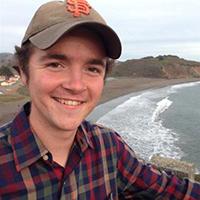
Lucas O. Seastrom is a writer, filmmaker, and contracting historian for The Walt Disney Family Museum.
Image sources (listed in order of appearance):
- Photograph – Michael Campbell assembling the Lilly Belle at The Walt Disney Family Museum, 2009; © Michael Campbell
- Photograph – Michael Campbell speaking at the opening event of All Aboard: A Celebration of Walt’s Trains at The Walt Disney Family Museum, 2014; © The Walt Disney Family Museum
- Photograph – Walt Disney, Ward Kimball, and a group of men in front of Ward Kimball’s Emma Nevada locomotive, c. 1940s; collection of the Walt Disney Family Foundation; © Disney
- Photograph – Walt Disney pulling the cord in the Ernest S. Marsh locomotive on the Disneyland Railroad, 1955; courtesy of the Walt Disney Archives; © Disney