
“Yo Ho (A Pirate’s Life for Me)”—the musical anthem of those many rascals and scoundrels we have adored for almost sixty years—is undoubtedly one of the most iconic Disney Parks songs. But how did this famous tune and its accompanying lyrics come to be? Hop in, landlubbers, and hold on tight—let’s take a little boat trip to find out…
Taking Tips from Treasure Island
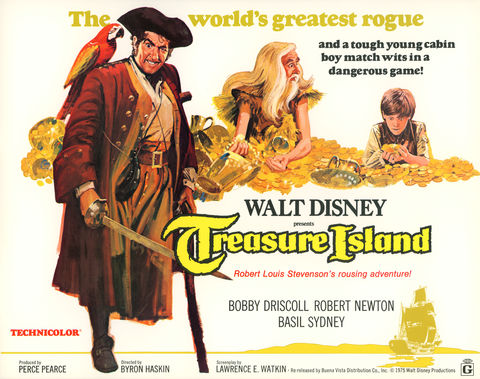
Walt Disney had always loved adventure stories, so when he had the opportunity to create his first full-length live-action feature film in 1949, Treasure Island felt like a natural choice to adapt for the screen. Disney Legend, actor Robert Newton was cast in the role of the charismatic pirate Long John Silver, and his unique dialect quickly became synonymous with all things buccaneer. “He had such a great, thick accent,” said Disney author Tim O’Day, speaking as part of the Behind the Attraction series on Disney+. “He set the standard for the way we think pirates talk. The whole ‘arr’—that came from a Disney movie!”
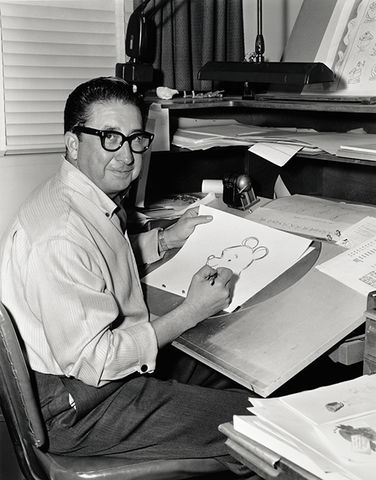
More than 15 years later, Imagineer and Disney Legend X Atencio was poised to delve into the lingo of Treasure Island (1950) in preparation for an upcoming pirate-themed Disneyland attraction. Walt challenged Atencio to write a script for this attraction—a task that felt a little overwhelming to the artist, whose work previously focused solely on animation and storyboarding. “I had never done any scripting before,” he later remarked, and the idea was “a little bit strange to me—but I said, ‘If Walt thinks I can do it, I probably can,’ so I went to work researching pirates. I read Treasure Island and looked at the picture that we had made to get the feeling of pirate jargon: the ‘avast there, matey’ sort of thing."
From Script to Song
Atencio quickly got to work on the script, leveraging concept art and miniature models that had been created by Imagineers and future Disney Legends Marc Davis and Claude Coats. When the script was finished, the team attended one final story meeting with Walt, where Atencio floated a new suggestion: “…I said, ‘I think we have an idea: a song for this thing. A song would be real good in this.’”
Atencio already had a melody in mind, starting with his “Yo ho, yo ho, a pirate’s life for me” lyrics—and when he shared these out loud, Walt told him to move forward with the idea, utilizing the skills of composer and fellow future Disney Legend George Bruns, who had already proven his skills with movies like Sleeping Beauty (1959) and attractions such as Walt Disney’s Enchanted Tiki Room. Atencio was surprised by Walt’s request. “I thought he was going to say to get the Sherman brothers to do it,” he admitted, “but he said go ahead, so I became a songwriter.”
A Pirate Party
When it came to creating the lyrics that would accompany Walt’s new pirate project, Atencio grappled with the musical mechanics of how each line might slot into an ever-moving attraction. As time went by, he and the team decided they would opt for looped lyrics that applied to the entirety of the attraction instead of a small section of it. “You never know at what point the audience is going to enter the scene,” Atencio later explained. “You can’t have a specific thought—you have to have a generic thing that no matter where you came in it would make sense, so each dance had to stand on its own. So, it’s a song without a beginning and without an end.” He added: “… You can’t say, ‘Well, here’s a pirate in a well,’ because you may not even be at the well yet. The challenges you had writing for those types of shows.”
Despite these challenges, Atencio enjoyed the opportunity to expand his vocabulary. “It was kind of fun doing the ‘Yo Ho’ song. I got my Roget’s Thesaurus, and I’d say ‘How about extort?’ We extort and pilfer, we pillage and sack, maraud, embezzle, and even hijack … [I used] all the synonyms for one particular word, and it worked out into a kind of nice little lyric.”
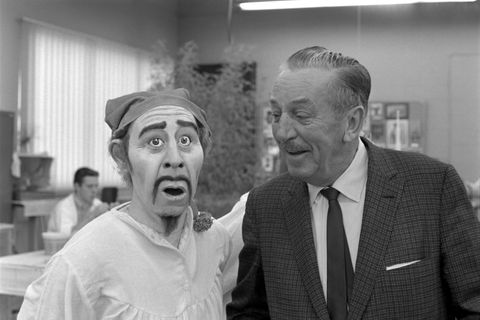
Later in the process, Walt’s team mocked up scenes from Pirates in the warehouse area at WED Enterprises, complete with sets and Audio-Animatronics® figures. Atencio recalled Walt visiting the warehouse to check in on progress, at which point the team used a dolly—a wheeled cart from movie sets—as a makeshift boat, pushing it through the mock-up scene-by-scene. But Atencio found himself embarrassed by the cacophony that awaited his boss: “We got a chair and moved it through, and turned on all the lights and the sound and everything, and I kind of apologized—I said, ‘Gee, Walt, I’m sorry, it’s so noisy! I can’t understand what’s going on here.’”
Walt wasn’t worried—instead, he famously commented, “Oh…, , X, it’s like going to a cocktail party.” Afterwards, Atencio reflected fondly on Walt’s assessment of the developing attraction: “He’d listen to a conversation here and he’d listen to a conversation there. Each time you go through, you find something different in there. And I says, ‘Why didn’t I think of that!’”
The Musical Maestros
By the beginning of 1966, George Bruns was sprinkling the finishing touches onto his part of this Pirates creation, ready for lead vocals to be recorded by voice actors Ernie Newton and Disney Legend Thurl Ravenscroft. Bruns used Atencio’s lyrics to produce a full theme and also worked with arranger Walter Sheets to write a range of variations on this theme—including an overture—using instruments such as the mandolin and the accordion.
Bruns appreciated Walt’s understanding that music needed to play an integral part in every Disneyland experience—he believed Walt thought of music as a “supporting actor” that would help to transport guests from A to B: “[Walt] used to say over and over again, ‘That’s what music’s got to do… when you’re dissolving from one place to another, it’s got to carry through it and carry that over.”
Disney Legend Buddy Baker, the composer who would later be responsible for “Grim Grinning Ghosts”—another iconic theme song for which Atencio would go on to pen the lyrics—also had a great respect for Walt’s musical sensitivity. “He had an uncanny sense of what music was right for a sequence,” said Baker. “I don’t think he knew ‘C’ from ‘F’—he wasn’t a schooled musician at all, but he had this uncanny sense of knowing if it should have a symphonic sound. In fact, he liked classical music a lot. And he would know when it should be a light tune … If you just listened to what he said, you wouldn’t ever go wrong.”
A Caribbean Classic
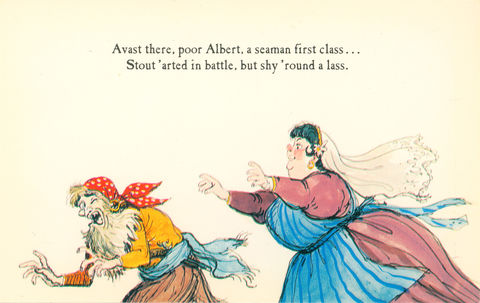
When Pirates of the Caribbean opened to the public in 1967, Walt Disney was not there to witness it—a source of great sadness for his grieving team. Atencio took some solace in the fact that Walt had been there to participate in the preparations for the attraction: “Yeah, you just wish he had been there to see it. But he was involved in it enough before he died. You felt sure that he would have been happy [with] what we were finally coming up with.”
Atencio and Bruns’s famous melody quickly became its own kind of cultural phenomenon. Instantly recognizable around the world, even almost six decades later, “Yo Ho (A Pirate’s Life for Me)” has been covered, sampled, and remixed. The song has been introduced to guests in Florida, Tokyo, Paris, and Shanghai, and even directly referenced in the historically successful movie franchise it helped to inspire.
“I was down in Laguna Beach one time several years ago and there were some kids in a little dinghy out there on the water singing ‘yo ho, yo ho, a pirate’s life for me.’ That made me feel good,” Atencio reminisced, sharing his pride in having contributed to such a cherished slice of Disneyland. “It[’s] really, you know, a good feeling to be involved in such a project. And it was all thanks to Walt. He was the guy that got it going.”

—Sophie Jo
Sophie Jo is an author and long-time Disney fan from England, who's never happier than when she's in a Doom Buggy. Her main focus for The Walt Disney Family Museum blog is Walt's 1950s/60s Disneyland.
Image Sources*:
- Photograph - Walt Disney with pirate figure, 1965; courtesy of the Walt Disney Archives; © Disney
- Re-release Lobby card - Treasure Island (1950, R. 1975); collection of the Walt Disney Family Foundation; © Disney
- Photograph - X Atencio at studio animation desk drawing Winnie the Pooh; courtesy of the Walt Disney Archives; © Disney
- Marc Davis; Disneyland Pirates of the Caribbean postcard, 1967; collection of the Walt Disney Family Foundation; © Disney