
“I always liked to show him something he hadn’t seen before.” That’s how Disney Legend and former Imagineer Rolly Crump once described his working relationship with Walt Disney in an interview with historian Jeff Baham.
Perhaps the most iconic story concerning Crump’s penchant for surprising the boss took place late in 1964. The 1964-1965 New York World’s Fair had opened in the Spring, and the Disney Imagineers were returning to earlier projects in development for Disneyland, among them the Haunted Mansion, which continued to lack a clear direction in its tone and thematic approach.
Having worked on the attraction in previous years, Crump decided to shake things up. “I didn’t like the direction the Mansion was taking—there was no imagination in it, nothing really too unique or different,” he would recall. “We needed to inject some weirdness.”
Embracing the Weird
Rolly Crump was nervous that the Haunted Mansion risked adhering itself to the tropes and gimmicks of traditional haunted houses. “He didn’t want it to be the typical ‘house of horror’ scary place,” explains Marie Tocci Crump, the late artist’s wife. “He knew it should be something different, and he and fellow Disney Legend and Imagineer Yale Gracey agreed about that, as did Disney Legend and Imagineer John Hench, I think.”
Conducting thorough research during his work on the Haunted Mansion, Crump discovered the 1946 film, Beauty and the Beast. French director Jean Cocteau’s treatment of the classic fairy tale—a story that Walt Disney himself had also been interested in developing—depicted a bizarre and often grotesque Beast’s castle, wherein everything from furniture to architectural fixtures were personified with human features. Live hands supported candelabras along the wall. Statues with living faces watched Belle as she made her way through the bewitched fortress.
Elements like these set Crump’s imagination afire. He spent weeks sketching what he’d call “really crazy concepts.” Among these whimsical peculiarities were a melting candle man, a talking chair, and a man-eating plant. The designs were both strange and entrancing. “Everything has a bit of humor, in spite of being a little surprising,” observes Marie. “I don’t want to describe those things as scary, because in truth they were like Rolly, they were just lovable [laughs].”
Pitching to Walt
“I feel now like I was there,” says Marie. “I heard Rolly tell the story so many times and I always loved to listen. He was such a good speaker, and I was his best audience.”
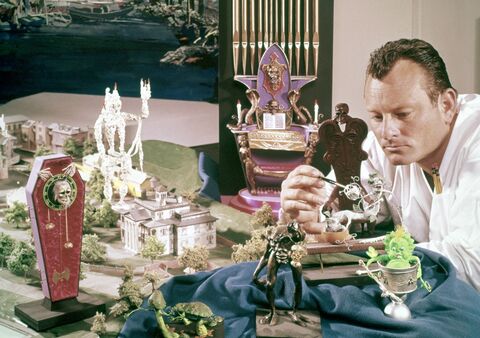
Crump worked with Imagineer Jack Ferges to create miniature figures based on his designs. When the creative leadership prepared a meeting with Walt Disney to discuss a number of concepts being considered for the Haunted Mansion, Crump recalled how his creations were placed inauspiciously in the corner of the room. It seemed that a number of his colleagues were skeptical, if not outright put off, by Crump’s artwork.
As the story goes, at the conclusion of a marathon review session, Walt happened to notice Crump’s work. Asking executive and future Disney Legend Dick Irvine what Crump was working on, Irvine responded, “We don’t know, you ask him.” Together, Walt and Crump sat at the table packed with the miniatures and drawings.
Walt was frank with the young artist. “This stuff is really weird, Rolly.” Crump acknowledged as much, telling the boss, “I’m not sure what they are, Walt…but I feel that unless we put something in that’s different, the Haunted Mansion is going to be just the same old thing.” Crump wasn’t afraid to admit to Walt that he didn’t have a specific concept for how these ideas might coalesce. “Rolly could not be anything but honest,” says Marie. “That’s just who he was. Rolly was just having fun with these designs.”
In the moment, Walt was at a loss, and then, seeming to confirm some of the other Imagineer’s feelings, he left the meeting without any further comment. But the next morning, Crump was surprised to find Walt sitting at his own desk, still wearing the same clothes from the previous day. He hadn’t slept the night before. Crump’s designs wouldn’t leave his thoughts. At first, the artist was apologetic, but Walt quickly shot back, “No, no, don’t be sorry. I’ve got this idea for it!”
Envisioning a Special Kind of Museum
“You have to understand that everything built at Disneyland during Walt’s lifetime were his ideas,” Crump would tell Jeff Baham. “He was the man. He stayed right with you on stuff until it was done.”
That morning at Crump’s desk, Walt explained to the artist how his bizarre concepts would be gathered into a special pavilion, a “Museum of the Weird,” that guests would traverse as they exited the Haunted Mansion, which, at the time, was still planned as a walkthrough attraction. The Museum would be presented as a veritable cabinet of curiosities, collected by some unknown source into a specially-curated setting. “Rolly was as surprised as everybody about Walt’s interest in it,” Marie notes.
Incorporating elements inspired by Crump’s lifelong interests in magic, the whole thing had an air of enchantment that felt more akin to Walt Disney’s Enchanted Tiki Room—an attraction that Crump had previously worked on—where the guests’ surroundings at first appear inert and unassuming, and then, ever so slowly, begin to come to life. “[...] That whole thing just showed me how beautiful the Old Man was,” Crump would tell writer Jeff Heimbuch about Walt’s creation of the Museum concept. “He was always open to these crazy ideas, and he worked with you to make them work.”
In 1965, Crump would appear with Walt and Disneyland’s first ambassador, Disney Legend Julie Reihm on television in an episode of Walt Disney’s Wonderful World of Color. Among other special appearances by Imagineers like Disney Legend Mary Blair, Marc Davis, and John Hench, Crump showed Walt and Reihm the Museum of the Weird miniatures, explaining that they had gathered “the weirdest things we could find” from all around the world.
Although details from the Museum were ultimately integrated into the ultimate Haunted Mansion that opened at Disneyland in 1969, the actual Museum of the Weird famously—or infamously—was not included in the final attraction. “Between the two of them, Walt and Rolly, they created this thing that, to this day, has not happened,” explains Marie. “In Rolly’s book [It’s Kind of A Cute Story, as told to Jeff Heimbuch], he discusses in detail what he envisioned the Museum to be, and had Walt lived, that’s what would’ve happened, Rolly felt. It wasn’t to be. But the Museum of the Weird still took on its own life.”
“If Walt hadn’t been serious about [the Museum of the Weird] he never would have put me on television to talk about it. It was his idea,” Crump would tell Baham.
A Magic-Infused Fortune Teller Wagon
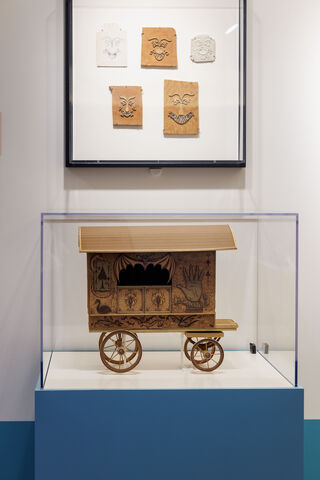
Currently on display in The Walt Disney Family Museum’s special exhibition, Happiest Place on Earth: The Disneyland Story, is an in-progress miniature of perhaps the largest set-piece intended for the Museum of the Weird: an elegant fortune teller wagon imbued with enchanted features. (And accompanying it are a handful of handmade stamps intended to mark gravestones, each invoking whimsical faces, perhaps inspired by Beauty and the Beast.)
Crump would compare the wagon to “it’s a small world’s” iconic clock tower, which “would come to life every so often, and put on a sort of show,” as he put it. “Flames would shoot out, doors would fly open, bells would ring and all sorts of magical, weird little stuff would happen.”
Crump also utilized his interests in magic and the performing arts for elements of the wagon. He described what he called “black art” techniques, where props are seemingly “floated” in mid-air by an artist wearing all black and moving against a black curtain under soft light. Crump had pursued magic since childhood, and as Marie notes, “In so many stories about creative people, it often goes back to magic and how it touched or influenced their lives. It’s so interesting to me.”
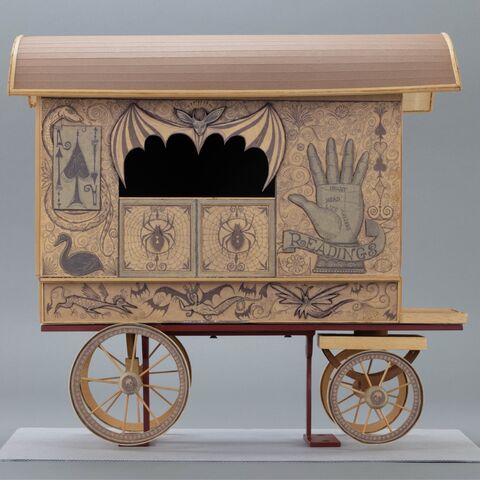
The museum’s miniature fortune teller wagon appears to be a work-in-progress. Final coloring and paint have not been applied, but several of Crump’s own intricate, ornamental illustrations are featured: bats and wing motifs, black widow spiders and webs, a palm reader’s hand, the ace of spades, and winged fauns. It is likely that Crump would have drawn these elements onto the miniature by hand.
What is unclear is the precise timing and context of this iteration. A finished miniature wagon was completed by Crump and Ferges by 1965 and appears on the Walt Disney's WonderfulWorld of Color television program. Was this other, incomplete version, a second iteration, intended to refine the ultimate, full-size incarnation that would have appeared in the Museum of the Weird itself?
A Dream Fulfilled
Though, lamentably, guests did not get to see the completed Museum of the Weird at Disneyland, Rolly Crump never forgot his beloved fortune teller wagon. He would incorporate similar concepts into later, independent projects as a theme park designer, including for the Knott’s Bear-y Tales attraction at Knott’s Berry Farm, not far from Disneyland, and for a character display at the AstroWorld theme park in Houston, Texas.
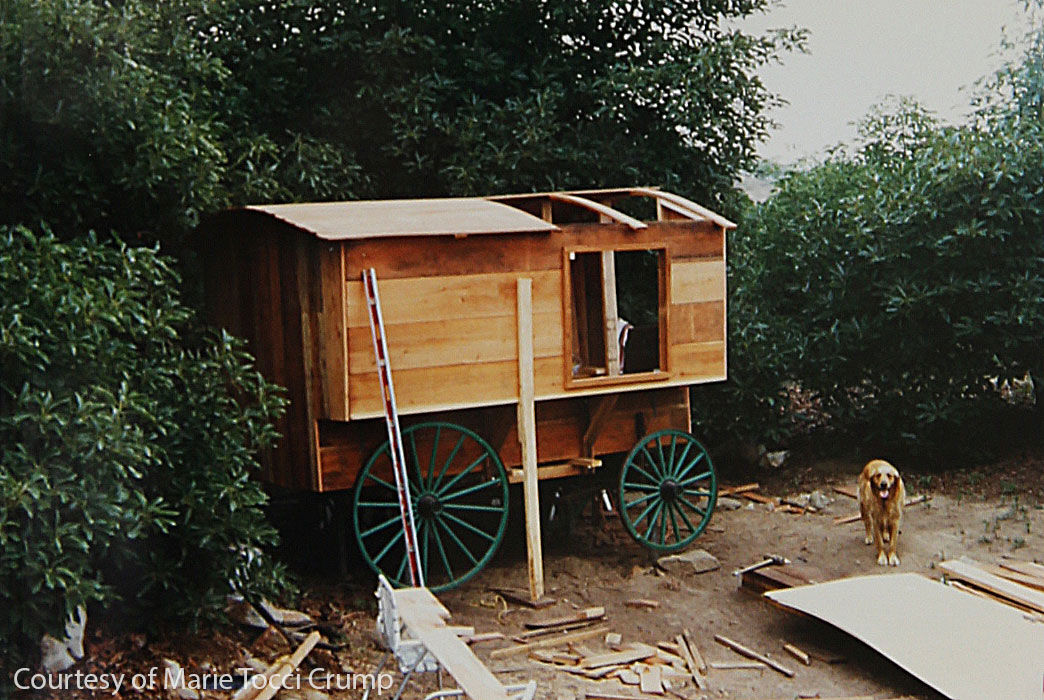
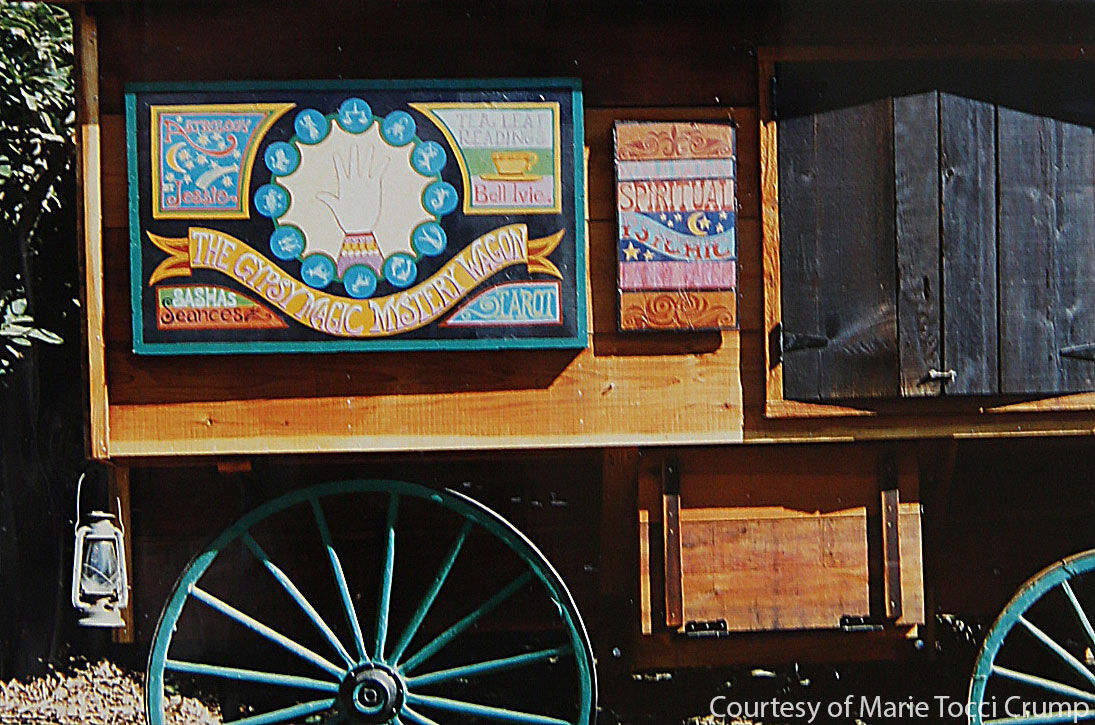
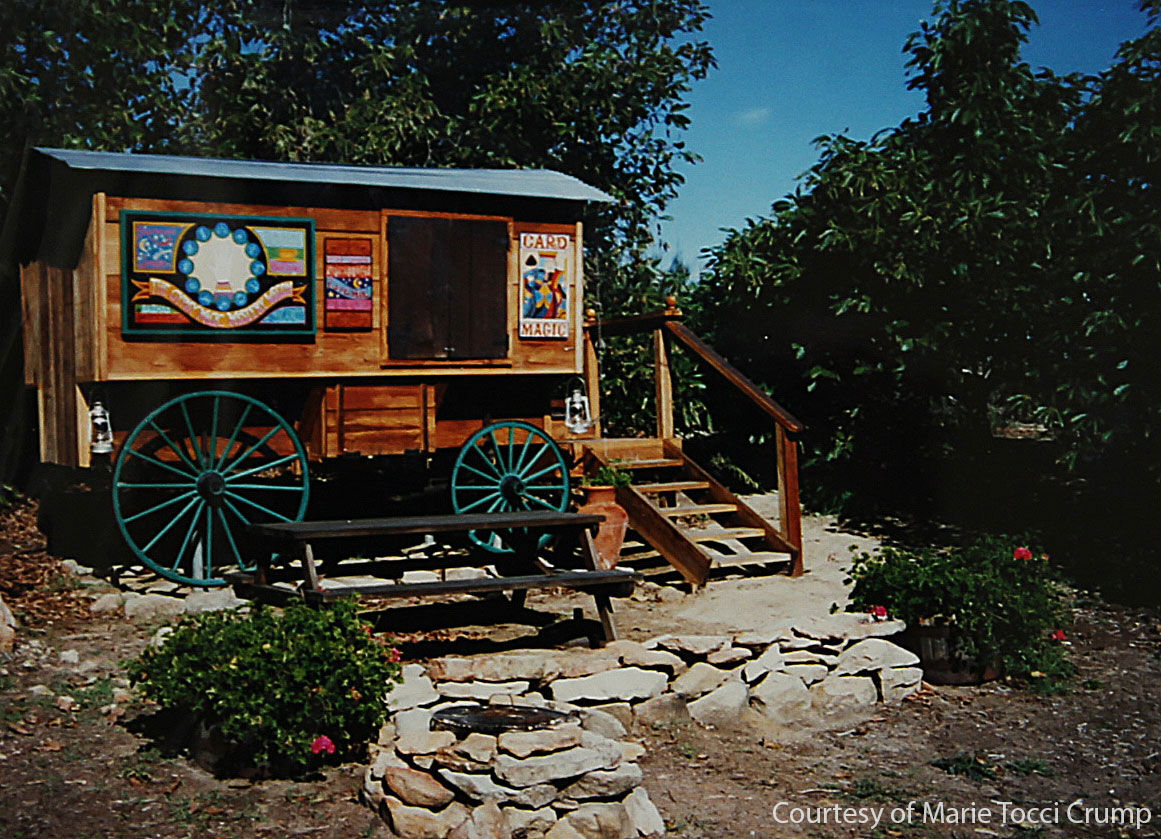
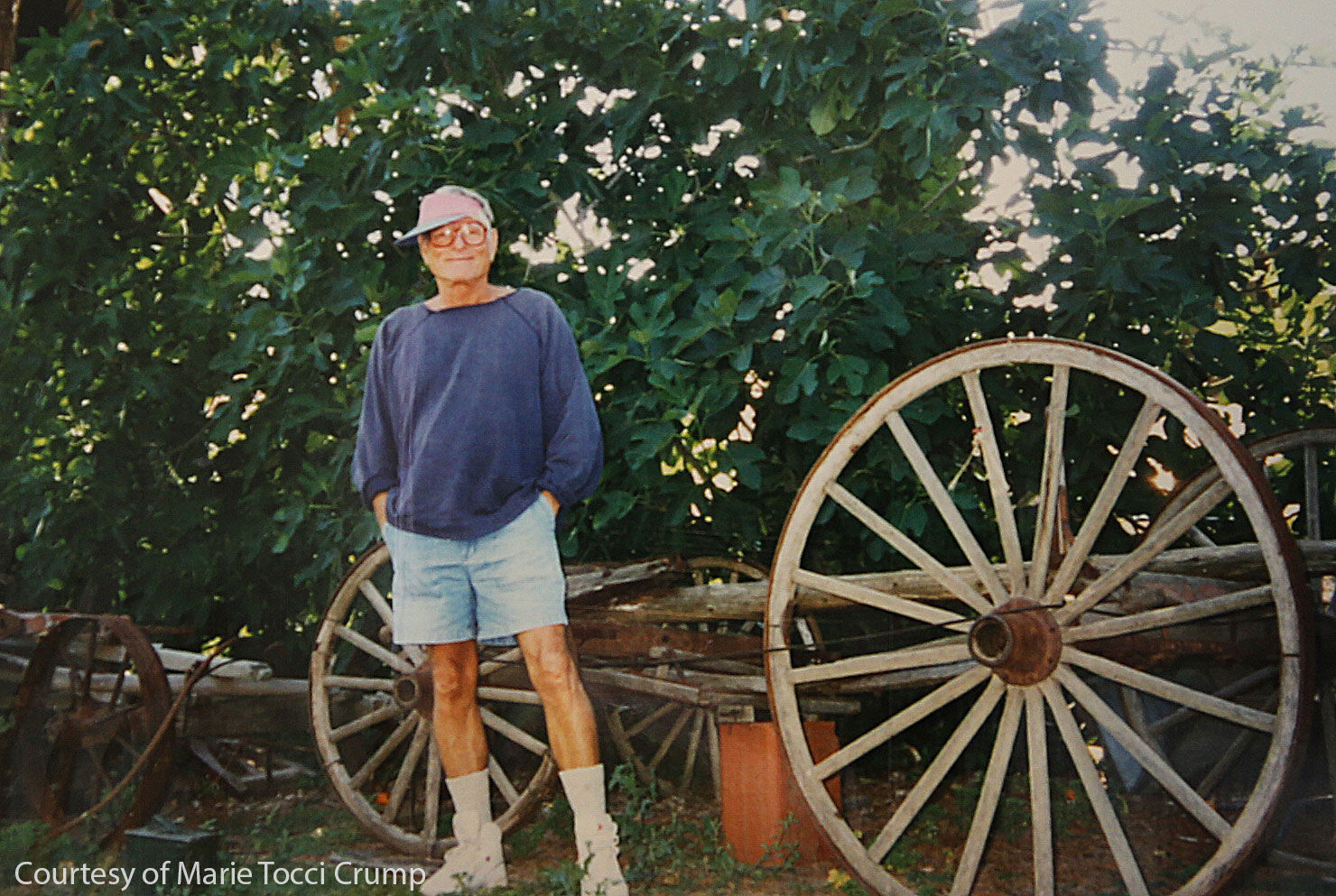
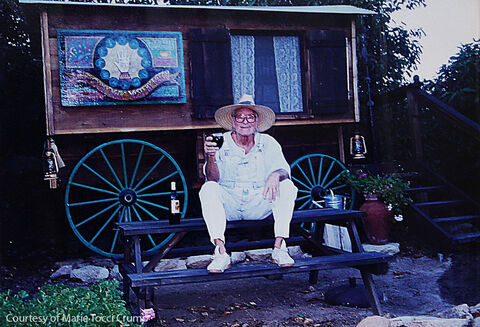
By the 1980s, Crump had created a custom wagon on his farm property near Fallbrook, California. There in the secluded hills, surrounded by avocado trees, existed his own private enclave sporting a life-size wagon that Marie describes as “storybook-like.”
Taking inspiration in part from a comparable piece built by interior designer Robin Roberts in upstate New York, Crump’s wagon was as colorful and whimsical as his original design. Dubbed the “Magic Mystery Wagon,” it included painted designs of a palm reader’s hand with references to tea readings, tarot cards, and seances. Marie recalls that “inside there was a lot of fabric and mixed textiles. Even though it was a small space, it was decorated beautifully.”
Walt, Rolly, and Their Legacy
The Museum of the Weird is arguably one of the most iconic of Disneyland’s unbuilt attractions, and continues to inspire elements in the Disney Parks, in addition to merchandise and offshoot stories.
“When I first met Rolly and we talked about the Museum of the Weird, he was surprised at how many of his fans already knew about it,” recalls Marie. “There was almost this underground group of Museum of the Weird lovers that he wasn’t even aware of. He wasn’t on the internet or anything like that, so he didn’t realize how people connected around the world and shared an interest in his work. There was an underlying mystery about this Museum and why it never happened, and I guess that’s one reason why it interested so many people.”
At the heart of the Museum concept is the mutual inspiration between Walt Disney and Rolly Crump, a creative bond that was distinctive even amongst the other Disney Imagineers of the era. “Everyone there had their specialties and were all beautifully talented in their own way,” Marie explains, “but Walt connected to Rolly’s childlike imagination because I think that’s who Walt was as well. That’s how Disneyland came to be after all.
“It’s my personal opinion—and I’d tell Rolly this all the time—that I think Walt loved Rolly’s imagination,” Marie concludes. “I believe that Walt might’ve seen himself in Rolly. There was a distinct connection between the two of them. The Museum of the Weird is a perfect example of that. When that meeting happened, and as Rolly would say, they rolled their chairs over to where his artwork was, and as they looked at everything, Walt asked, ‘What are we going to do with all of this?’ And Rolly kept saying, ‘I don’t know.’ And I’m sure he didn’t. He just knew that, in his mind, those creative images should become part of the Haunted Mansion.”
—Lucas O. Seastrom
Lucas O. Seastrom is a writer, filmmaker, and contracting historian for The Walt Disney Family Museum.
Image sources (listed in order of appearance):
- Photograph – Rolly Crump adjusts sculptures he created with Jack Ferges for various tableaux within the Museum of the Weird, c. 1960s; courtesy of Walt Disney Imagineering Photo Collection; © Disney
- Photograph – Museum of the Weird cart; Happiest Place on Earth: The Disneyland Story, 2025; The Walt Disney Family Museum
- Photograph – Rolly Crump with the “Magic Mystery Wagon”, c. 1980s; courtesy of Marie Tocci Crump