
For celebrated artist Josh Agle, growing up with annual visits to Disneyland® Park helped shape his literal world view. “I’m a really visual person,” he explains, “so I think in images more than words, and Disneyland is a very visual place. It’s designed in a way that everywhere you look, there’s visual eye candy, and it’s put together in a way that is escapist and immersive. I think Disneyland in Anaheim, [California] does it better than any of the other Disney parks because they have limited space. They couldn’t expand and triple the size of the park, so they had to fit it all in. Disneyland has the most visual impact per square inch of anywhere on this planet.”
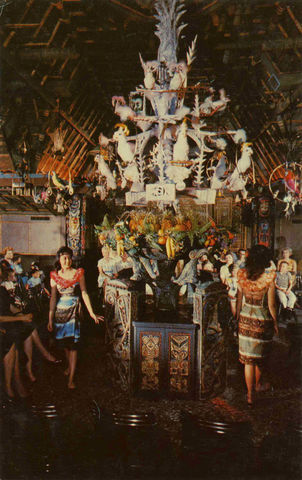
Better known worldwide by his artist name “Shag”—the combination of the final two letters in his first name and the first two of his last name—Agle has spent decades creating fine art pieces for Disney, and in particular, subjects related to Disneyland. “Walt Disney’s Enchanted Tiki Room has a special place for me because that was the first project I worked on for [T]he [Walt] Disney Company, for the 40th anniversary of the attraction [in 2003],” Agle says. “I think they reached out to me because I was already painting a lot of tikis and tiki bars, so it seemed like a natural fit.”
Since childhood, Agle had enjoyed the park’s Adventureland setting, perusing tiki neck charms and rubber snakes at the Adventureland Bazaar, “attracted and intrigued” by the visual designs, as he puts it. But surprisingly, he did not encounter the Enchanted Tiki Room until adulthood. Growing up with annual visits to Disneyland, Agle devoted as much time as possible to iconic thrill attractions like the Matterhorn Bobsleds or Space Mountain. By his early 20s, already a devotee of tiki bars and their related culture, Agle experienced what was for him a new kind of Disneyland attraction.
“I just remember being blown away by it,” he recalls. “The singing birds were awesome, of course, but it was the fact that those tikis had been in the corner of the room that whole time, and then they suddenly started moving and singing. That was completely unexpected to me. They were at the same level as the people sitting there in the room. I love that because in almost every other attraction you’re separated from the [Audio-]Animatronics® [figures] in a boat or something like that. In the Enchanted Tiki Room, you could get right up close with the singing tikis, and that is so special.”
Immersive Disneyland
For Agle, the Enchanted Tiki Room, along with other attractions like Pirates of the Caribbean, the Haunted Mansion, and “it’s a small world” represent Disneyland at its best, what he calls “the most immersive attractions in the entire park.” With the Enchanted Tiki Room’s magical rain showers or the eternal night of Pirates of the Caribbean or the Haunted Mansion, “They take you completely out of the real world,” as Agle explains. “You can forget about where you are and be transported, the same way that a really great movie does when you’re in a theater and you’re transported into the world of that movie.”
Such a vibrant mix of stories and experiences reflects Walt Disney’s own innate sense of curiosity. “Walt was a creative person, and creative people are always looking for inspiration wherever they can find it,” Agle observes. “I think he was inspired by futurism—the optimism of the future—but also his childhood, his small town, Midwestern upbringing. He was always looking for inspiration. The future is optimistic and a fun place to be. The past is nostalgic and also a fun place to be.”
Agle’s own creative work was once described as “aspirational,” imbued with a sense of optimism and the ability to visualize one’s own dreams. “I was painting places I wanted to be, parties I wanted to be at, or pieces of architecture I wanted to be in,” he notes. “It was like painting a future life that I hoped one day I would be able to obtain.” The artist sees Walt Disney’s example as aspirational in its own way. “Entrepreneurial people have that aspirational mindset. When Walt was making Snow White [and the Seven Dwarfs (1937)], he bet it all on that film, and it paid off. Disneyland was kind of the same way.
“He assembled this group of artists and asked them to conceptualize this theme park, so for them, it’s aspirational as well,” Agle continues. “When you’re painting a concept of the Jungle Cruise or the castle, you don’t know if it’s going to get built. You hope Walt signs off on it. I think this is part of the aspirational quality of the art made for Disneyland.”
Agle is quick to add that his visits to The Walt Disney Family Museum over the years “have given me a much broader appreciation of what Walt went through to get to where he finally ended up,” as the artist explains. “The way it’s presented at the museum, taking you through this timeline, is brilliant. I didn’t know what Walt was doing in his life before he made Snow White or what he went through to found the company.”
Mary Blair: Lessons in Color
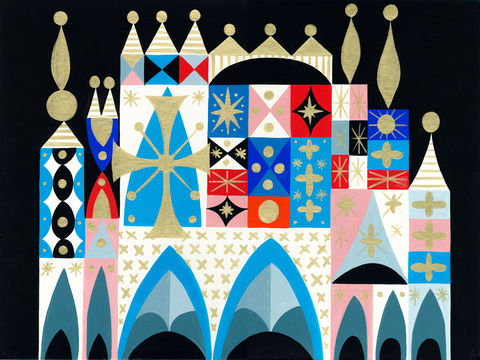
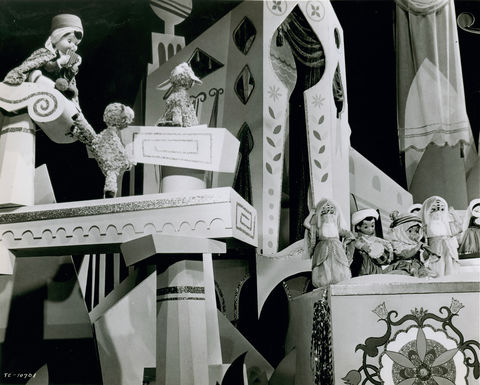
Though he didn’t realize it at the time, Agle’s childhood experience riding it’s a small world at Disneyland introduced him to the artwork of Disney Legend Mary Blair. Arguably one of Walt Disney’s most favorite of the studio’s artists, Blair influenced iconic animated films like Cinderella (1950) and Alice in Wonderland (1951) before assisting in the design of the "small world” attraction in the 1960s.
The example of Blair’s work for “it’s a small world”, in particular, became ubiquitous in popular culture, even if most people did not know who had created the distinctive style. “When I was nine or ten,” Agle recalls, “my mom made this themed Christmas tree, and she created little dolls of children from all over the world. I thought she was a genius and it wasn’t until years later that I realized she was taking that idea from Mary Blair [laughs]!”
Around the same time that Agle was commencing his working relationship with Disney, Mary Blair’s legacy began to experience a resurgence of popularity and interest, with art prints for sale and John Canemaker’s seminal book, The Art and Flair of Mary Blair, being published.
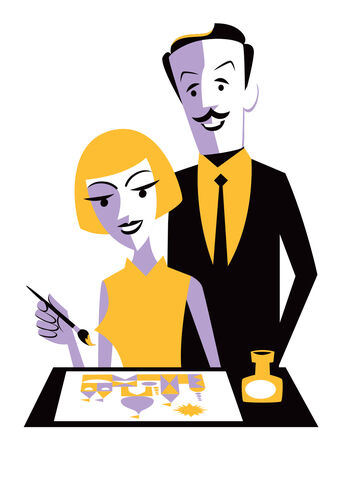
Agle credits this new Blair renaissance as helping further the appeal of his own work. “I think it’s why my collaborations with Disney were really successful when we started working together,” he explains. “Disney wasn’t using that style in their merchandising or promotion. I was thinking back to my childhood when that style was prevalent. That’s what I wanted to recall when I started with Disney, the Mary Blair and [Disney Legend] Rolly Crump approach, which they weren’t emphasizing at the time.”
One cannot discuss Mary Blair’s artistic style without mentioning her bold choice of colors, which Agle describes as nothing short of courageous. “During her time, everybody else was a little more timid with colors. She was not afraid of them.” As an admirer of her work, Agle has made a study of Blair’s technique, which draws parallels to his own.
“One thing I like about Blair’s color choices is that she was not afraid of using color at its full strength,” he observes. “If there’s going to be lime green, it’s going to be a bright lime green, and it’s going to look even brighter because there’s orange next to it, which is a complimentary color. Another Disney artist like [Disney Legend] Eyvind Earle was a little more cautious, using some more muted colors. His work is still colorful, but it isn’t like Mary Blair’s. She went 100% with the color. It’s something I do in my own work, and Blair has been a big influence in that way. If I’m using purple, I’m going to go really purple. When I started, I got flack from some other artists who said, ‘Why is your stuff so bright?’ It’s what I liked.”
Art that Tells a Story
During her time as a concept artist for Disney animated features, Blair was responsible for developing images that could inspire moments in a story and the place of characters within them. In particular, she had a well-practiced ability to convey the specific emotion of a story.
“The things that tell the story in an image are the main character, their expression in their face, and how the other characters and objects in the piece relate to them,” Agle explains. “Mary Blair was really good at arranging those things in a way that you look at it and get a piece of the story.”
Agle recounts how, early in his own artistic career, he chose to imbue his paintings with narrative elements to help them stand out from their counterparts. “When I had my first paintings in a real art gallery, it was a group show. There were around 30 other artists in the show, and I remember thinking, ‘How can I get people to look at my pieces?’ I thought that I could tell a story and set it in the middle of the story arc, so that when you look at it, you have to figure out what happened before and what happened after. That was an attempt to get people to spend a few seconds on my painting versus the painting next to me [laughs]. It worked to an extent.”
Sometimes the stories in a Shag painting are more obvious than in others, and the artist makes a point to never explain the exact scenario that is depicted. “I tell people, ‘Come up with what you think is going on, because what you come up with might be better than what I was thinking.’”
Capturing Blair’s Life in Art
In recent months, Agle has been collaborating with the Mary Blair family estate, directed by Blair’s own niece, Maggie Richardson, to create a new Shag painting that captures an impression of Mary Blair’s home life.
“I want to depict Mary working in her studio, probably the one where she lived in New York because, architecturally, it’s really cool,” Agle says. “But I also want to capture some of her daily life as well. She had two kids and a husband who was also an artist. She was very design-forward. Her house was mid-century modern. The family had two pets. And I want to include some of her iconic artwork hanging in her studio. I really want to showcase the work she did as well as her life as an artist, wife, and mother.”
As Agle’s own observations attest, artists like Mary Blair and Walt Disney can help teach us that we can all find ways to make our own lives works of art in themselves.
–
Visit Shag’s website for the latest news and information about his art.
Visit the Magic of Mary Blair website to discover more about one of Walt Disney’s favorite artists.

—Lucas O. Seastrom
Lucas O. Seastrom is a writer, filmmaker, and contracting historian for The Walt Disney Family Museum.
Image sources (listed in order of appearance):
-
Mary Blair; Concept art – it’s a small world, c. 1966; collection of the Walt Disney Family Foundation; © Disney
-
Postcard – Walt Disney’s Enchanted Tiki Room, Disneyland; collection of the Walt Disney Family Foundation; © Disney
-
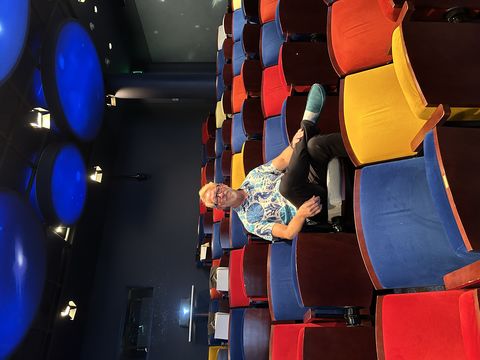
Photograph - Shag at The Walt Disney Family Museum theater, 2025; © The Walt Disney Family Museum
-
Shag; Mini print - “Mary and Walt”, 2025; © Shag
- Photograph - it's a small world, 1964; collection of the Walt Disney Family Foundation, Gift of Jeanne Chamberlain and Maggie Richardson; © Disney